
The modern automotive landscape has changed dramatically under the hood and behind the dashboard. Drive down any city street, and you will notice a common mechanical rhythm: engines cutting out smoothly at red lights and instantly firing back up the second the driver’s foot lifts off the brake. While automatic stop-start systems play a vital role in curbing fuel consumption and lowering urban emissions, they place an extraordinary burden on a vehicle’s electrical architecture.
Traditional flooded lead-acid batteries, which served cars reliably for decades, simply lack the structural endurance to handle this repetitive, high-stress cycling. To meet the rigorous demands of modern electronics and frequent engine restarts, Absorbed Glass Mat (AGM) batteries have emerged as the indispensable gold standard for contemporary vehicles.
The Evolution of Electrical Loads in Modern Vehicles
Decades ago, a car battery had a relatively straightforward job: provide enough cold-cranking amps to start the engine, run basic headlights, and power a simple radio. Once running, the alternator took over everything. Today’s vehicles function much more like rolling supercomputers.
Modern cars are packed with power-hungry systems:
- Advanced Driver-Assistance Systems (ADAS) with active radar, cameras, and collision-avoidance sensors.
- Multiple infotainment screens, digital instrument clusters, and continuous cellular data connectivity.
- Complex climate control blowers, heated seats, and sophisticated onboard computers.
When an automatic stop-start system shuts off the engine at a stoplight, the alternator stops spinning. Despite this, all of the vehicle’s onboard accessories must keep running seamlessly without a dip in power. The moment you take your foot off the brake, the starter motor must violently and instantly crank the engine back to life—all while the battery is already operating in a partial state of discharge. This continuous cycle of heavy draining and immediate recharging creates an environment where standard batteries degrade rapidly.
How AGM Technology Works
To understand why AGM batteries thrive under these conditions, it helps to look inside their casing. Unlike conventional flooded batteries that store liquid electrolyte sloshing freely around lead plates, Absorbed Glass Mat technology uses fine, highly porous fiberglass mats.
- The Matrix Design: These microscopic glass fiber mats are saturated with just enough sulfuric acid electrolyte to keep them wet, held under constant compression tightly sandwiched between the positive and negative lead plates.
- Structural Durability: Because the electrolyte is absorbed rather than liquid, the internal components are locked firmly in place. This makes AGM batteries exceptionally resistant to physical shock and vibration, completely spill-proof, and immune to internal acid stratification.
- Rapid Charge Acceptance: AGM batteries feature exceptionally low internal resistance. This allows them to absorb electrical current from the alternator much faster than traditional batteries, ensuring they replenish their charge quickly during short city drives.
Performance Benefits in Real-World Driving
Switching to or replacing your vehicle with an OE-spec AGM battery unlocks distinct, measurable performance advantages:
- Extended Cycle Life: Standard flooded batteries suffer when kept in a partial state of charge. AGM batteries endure thousands of charge-discharge cycles without losing overall capacity, translating to years of reliable service even in heavy stop-and-go commuter traffic.
- Superior Cranking Power (CCA): Even on freezing winter mornings when oil is thick and engines resist turning over, AGM batteries deliver high cold-cranking amps with minimal voltage drop.
- Uninterrupted Accessory Power: Because of their deep-cycling design, AGM units maintain stable voltage levels while the engine is resting at a stoplight. This prevents common electrical glitches, flickering dashboard lights, or sluggish restarts.
Maintenance, Replacement, and Battery Registration
Because AGM batteries are engineered for specific vehicle electrical demands, proper handling during replacement is critical:
- Never Downgrade: If your vehicle came equipped with an AGM battery from the factory, you must always replace it with another AGM battery. Dropping down to a conventional flooded battery will lead to premature failure and potential electrical system faults.
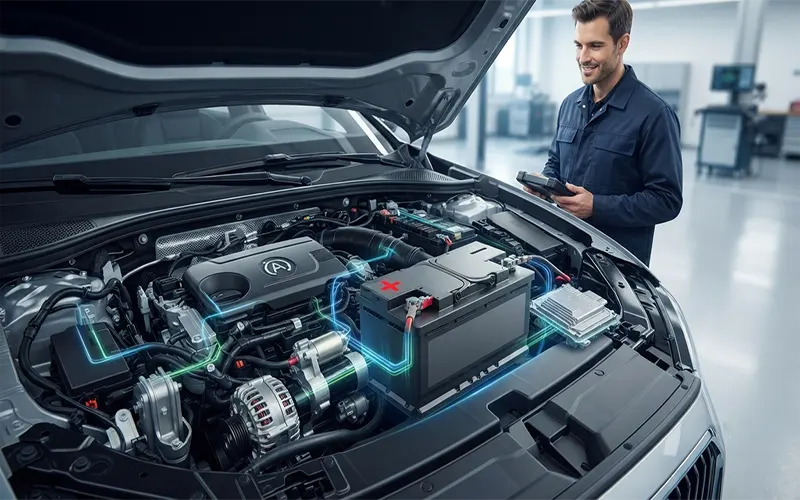
- Battery Management System (BMS) Reset: Modern cars utilize intelligent charging sensors that monitor battery age, state of charge, and internal resistance to optimize alternator output. When installing a new AGM battery, a scan tool or proper electronic procedure is often required to reset the BMS, ensuring the car recognizes the fresh battery and charges it correctly.
Automatic stop-start systems and advanced vehicle electronics have permanently redefined what we expect from automotive power sources. High-performance AGM batteries provide the robust chemical engineering and rapid charge acceptance required to handle these heavy demands effortlessly. Investing in a quality AGM battery ensures optimal vehicle reliability, protects sensitive onboard electronics, and keeps your stop-start system operating efficiently for the long haul.