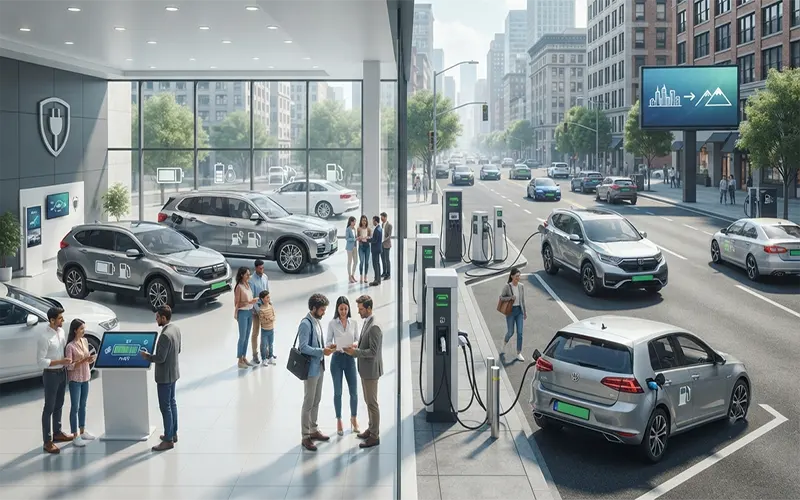
The global transition toward vehicle electrification has entered a fascinating new phase. For years, the market narrative operated on a rigid, all-or-nothing approach, framing the future entirely around pure battery-electric vehicles (BEVs). However, consumer habits, infrastructure bottlenecks, and economic realities have reshaped showroom floors.
The undisputed rising stars of modern auto sales are Plug-In Hybrid Electric Vehicles (PHEVs) and Extended Range Electric Vehicles (EREVs). By successfully combining daily emission-free electric driving with a gasoline backup, these powertrains are capturing massive market share by completely eliminating range anxiety and charging friction.
Defining the Powertrains: PHEVs vs. EREVs
While both vehicle types bridge the gap between internal combustion and full electrification, their internal mechanical designs differ significantly:
- Plug-In Hybrid Electric Vehicles (PHEVs): PHEVs feature a blended architecture combining a traditional internal combustion engine (ICE) with an electric motor and battery pack. Both the electric motor and the gas engine can mechanically drive the wheels directly, working in tandem or independently depending on driving conditions.
- Extended Range Electric Vehicles (EREVs): EREVs operate as a series hybrid. In an EREV, electric motors exclusively propel the wheels at all times, providing the smooth, instant torque characteristic of a pure BEV. The onboard internal combustion engine does not connect to the wheels at all; its sole purpose is to act as an internal generator to recharge the high-voltage battery pack when it runs low.
Both architectures offer a robust middle-ground solution that appeals directly to motorists looking to slash fuel consumption without altering their driving habits.
The Consumer Psychology: Cracking Range Anxiety and Infrastructure Gaps
Despite rapid expansions in public charging networks, pure BEV adoption continues to face real-world friction points among mainstream and conservative buyers. Patchy charging stations in rural areas, long highway queues during peak holiday travel, and noticeable cold-weather range reduction remain significant deterrents.
PHEVs and EREVs completely neutralize these psychological hurdles through a simple concept: the security blanket of a gasoline backup.
- Daily Utility: Statistics show that the vast majority of daily commutes fall well within 30 to 60 miles. Owners can complete their entire everyday routine—commuting, school runs, and grocery shopping—entirely on zero-emission electric power by plugging in overnight at home.
- Long-Distance Freedom: When weekend road trips or unexpected long-distance driving arise, the driver simply pulls into a standard gas station, fills the tank in minutes, and continues driving without planning a route around high-speed DC fast chargers.
Market Momentum and Sales Data: The Numbers Behind the Trend
Global sales data underscores this massive consumer shift. Across major automotive markets—particularly in China, Europe, and emerging regions—electrified hybrids have surged forward, frequently outperforming pure BEV growth rates during periods of shifting consumer incentives.
Recognizing this trend, major global automakers have aggressively shifted R&D and capital investment back toward flexible hybrid architectures. Rather than waiting for public charging infrastructure to catch up with 100% BEV mandates, manufacturers are meeting buyers where they are: demanding immediate efficiency without lifestyle compromises.
Economic and Environmental Efficiency
Beyond consumer convenience, EREVs and PHEVs offer powerful supply-chain and manufacturing advantages:
- Smaller Battery Packs: Because these vehicles carry smaller battery capacities than long-range BEVs (typically 15 to 40 kWh instead of 80 to 100+ kWh), they require significantly fewer scarce critical minerals like lithium, cobalt, and nickel.
- Lower Sticker Prices: Reduced battery production costs translate directly to more competitive vehicle price tags, making electrified driving accessible to a wider demographic of budget-conscious buyers while still slashing daily urban tailpipe emissions.
Extended-range electric vehicles and plug-in hybrids are far more than a temporary market compromise. By offering the best of both worlds—clean, low-cost electric commuting paired with the ultimate safety net of liquid fuel—EREVs and PHEVs have firmly established themselves as a dominant driving force shaping the future of global automotive sales.