The electric vehicle (EV) industry has long chased a singular technological holy grail: the solid-state battery. For years, range anxiety, safety concerns regarding thermal runaway, and lengthy charging times have acted as the primary friction points slowing mainstream EV adoption. Traditional lithium-ion cells, while vastly improved over the past decade, are rapidly approaching their chemical and physical performance ceilings.
Enter solid-state architecture. By swapping out volatile liquid or gel electrolytes for stable solid materials, this next-generation technology promises to completely redefine what drivers can expect from electric mobility. However, separating industry marketing hype from commercial reality requires a close look at both the staggering performance metrics these batteries promise and the complex manufacturing hurdles governing their rollout timelines.
The Science Behind Solid-State Batteries
To understand why solid-state batteries represent a paradigm shift, one must look at how standard lithium-ion cells are built. Conventional batteries rely on a liquid or polymer-gel electrolyte solution to shuttle lithium ions back and forth between the cathode and anode. While effective, these liquid electrolytes are flammable and susceptible to forming microscopic, needle-like structures called dendrites over time. If a dendrite grows large enough to pierce the separator separating the positive and negative sides, it causes a short circuit, potentially leading to thermal runaway and fire.
Solid-state batteries replace that liquid medium entirely with a solid electrolyte—typically constructed from ceramic, sulfide, or solid polymer materials.
- Intrinsic Safety: Because there is no flammable liquid “juice” inside, the risk of fire or explosion is virtually eliminated, even under extreme physical stress or high-temperature operations.
- Unlocking High-Capacity Anodes: Solid electrolytes effectively block dendrites, allowing engineers to transition away from traditional graphite anodes and utilize pure lithium-metal anodes. This shift dramatically increases the amount of energy packed into a given space.
Fast-Charging and Performance Metrics: What the Data Shows
The performance projections associated with solid-state cells read like science fiction, yet laboratory and pilot-line data indicate they are entirely achievable once manufacturing challenges are tamed.
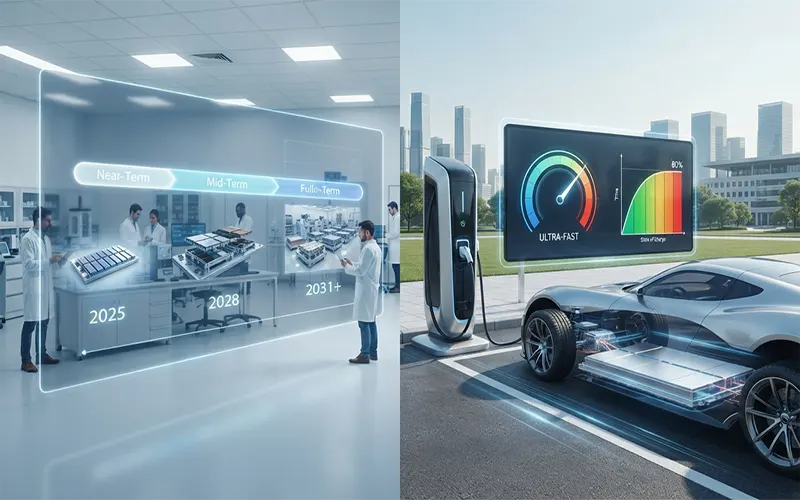
- Revolutionary Charging Speeds: Liquid electrolytes break down under high electrical currents, limiting how fast energy can be pumped into a car. Solid electrolytes, by contrast, tolerate much higher thermal and electrical thresholds. Industry roadmaps and manufacturer testing data suggest solid-state packs will slash standard 10% to 80% DC fast-charging intervals down to under 10 or 15 minutes, turning long road trips into effortless pit stops.
- Massive Energy Density and Range: While conventional lithium-ion packs hover around 200 to 260 Wh/kg, solid-state cells are projected to easily reach 350 to 500+ Wh/kg. For the average consumer, this means a battery pack half the physical weight of today’s units could effortlessly deliver 1,000+ kilometers (620+ miles) of driving range on a single charge.
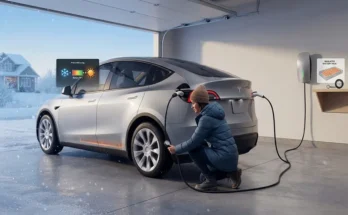
- Climate and Cycle Resilience: Solid-state chemistry demonstrates exceptional resilience in sub-zero environments, retaining a vastly higher percentage of usable capacity in freezing winter conditions compared to liquid-based packs. Furthermore, their stable internal structure points toward extended lifespans, enduring thousands of deep-charge cycles without meaningful degradation.
Commercialization and Market Rollout Timelines
Despite glowing performance metrics, moving solid-state batteries from experimental laboratory benches to millions of consumer vehicles is a monumental engineering trial. Automakers and tier-one suppliers face strict manufacturing hurdles, including managing high interface resistance between solid layers, preventing microscopic cracking during expansion and contraction, and scaling complex roll-to-roll production lines.
Consequently, the industry rollout is following a structured, multi-phase timeline:
- Phase 1: The Semi-Solid Stepping Stone (Mid-2020s): Before pure all-solid-state cells take over, the market is seeing an influx of “semi-solid” or hybrid cells—batteries utilizing a very small percentage of liquid or gel binder alongside solid matrices—deployed in select high-end vehicles and long-range luxury models.
- Phase 2: Initial Pilot Production & Premium Debut (Late 2020s): Major global manufacturers and automotive brands are initiating limited pilot production lines and small-series fleet testing. Initial all-solid-state vehicles are targeted to enter the market in limited numbers, typically restricted to flagship high-performance or luxury segments where buyers can absorb elevated initial costs.
- Phase 3: Mainstream Mass Production (2030 and Beyond): Industry consensus indicates that true volume manufacturing, optimized supply chains, and cost parity with conventional lithium-ion will not materialize broadly until the turn of the decade.
Bridging the Gap: The Interim Role of Advanced Lithium-Ion
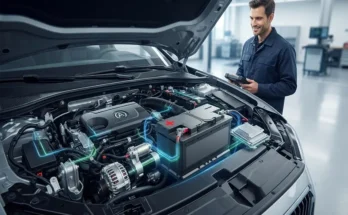
Because full-scale solid-state rollout will take time, the automotive industry continues to rely on high-performance evolutionary chemistry to bridge the gap. Advanced high-silicon anodes, improved nickel-manganese-cobalt (NMC) configurations, and low-cost lithium iron phosphate (LFP) packs will continue to anchor high-volume EV deliveries for the foreseeable future, ensuring that electric cars remain accessible while solid-state manufacturing matures.
Solid-state batteries represent the ultimate destination for electric mobility, offering a transformative blend of unmatched range, lightning-fast charging speeds, and absolute safety. However, their arrival is unfolding as an incremental engineering marathon rather than an overnight revolution. As pilot lines scale and initial commercial batches hit the pavement, solid-state technology is steadily paving the way for a future where range anxiety and long charging stops become relics of the past.