For over a century, the interior architecture of the automobile has been bound by a single rigid constraint: the human driver. Every seat, dash panel, and control surface was meticulously arranged facing forward, optimized for the singular task of steering down a highway. Today, as software-driven autonomy marches steadily toward reality, that foundational constraint is dissolving.
When human drivers are permanently relieved of steering duties, the purpose of the car cabin changes entirely. Autonomous vehicle (AV) concepts featuring rotating seats and modular layouts are redefining luxury, transforming transit time from a high-vigilance chore into mobile productivity and relaxation sanctuaries.
The Death of the Traditional Cockpit
To grasp the scale of this design revolution, one must look at how Level 4 and Level 5 autonomous driving systems alter vehicle packaging. In a fully autonomous vehicle, the steering wheel, foot pedals, and fixed instrument clusters become obsolete dead weight.
Without the need to pilot the machine, the entire front-row footprint opens up. Designers no longer have to design around a forward-facing driver’s position. This spatial liberation unlocks unprecedented interior volume, allowing automotive studios to treat the cabin less like a cockpit and more like a mobile architectural room.
Rotating Seats and Reimagined Social Layouts
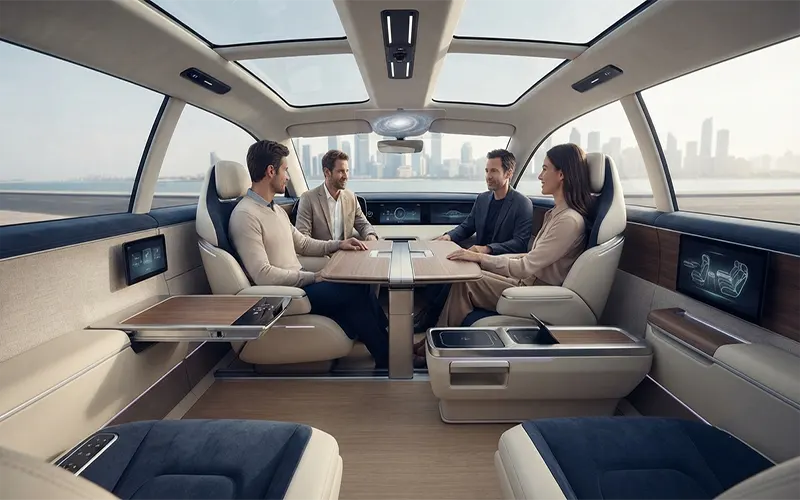
The centerpiece of this new interior philosophy is the swiveling seat. Modern autonomous concepts feature seats capable of sliding on floor tracks, reclining into zero-gravity postures, and rotating up to 180 or 360 degrees.
This mechanical flexibility allows the cabin to morph dynamically depending on passenger needs:
- Productivity Mode: Seats face forward with integrated deployable tray tables and screens, turning the vehicle into a private mobile conference room or workstation.
- Social Mode: Front-row seats swivel backward to face the rear passengers, creating an intimate, living-room-style conversation circle where occupants can interact naturally during transit.
- Rest Mode: Seats recline into lie-flat configurations complete with integrated footrests and privacy shades, allowing passengers to sleep during long journeys.
Modular Living Spaces and Adaptive Materials
Beyond flexible seating, autonomous luxury concepts embrace modularity to adapt to changing activities on the fly.
- Adaptive Storage and Partitions: Retractable partitions can separate the cabin into private zones, while modular storage bins snap magnetically into place to hold devices, refreshments, or work gear.
- Residential Aesthetics: Interior surfaces abandon cold plastics in favor of sustainable luxury materials. Biophilic textiles, warm recycled woods, ambient lighting profiles, and acoustic damping materials are engineered to evoke high-end residential living rooms rather than traditional car interiors.
Safety Challenges in a Unbelted Lounge
While a lounge-like interior is deeply appealing, it introduces massive engineering hurdles for occupant safety. Traditional three-point seatbelts and front-facing airbags are designed strictly for a forward-collision vector.
If passengers are turned sideways or reclined flat, standard safety systems fail. To solve this, automotive engineers are pioneering innovative restraint technologies:
- Seat-Integrated Airbags: Airbags and multi-point seatbelts are built directly into the seat frames themselves, ensuring that no matter how a seat is rotated or reclined, the occupant remains securely restrained to their individual seat structure.
- Adaptive Crash Dynamics: Cabin sensors dynamically adjust airbag deployment angles and seat positioning milliseconds before an unavoidable impact to protect unbelted-style seating layouts.
As vehicle autonomy matures, modular luxury car interiors will fundamentally transform our relationship with transportation. By blending architectural design, flexible seating, and advanced safety engineering, tomorrow’s cars will cease to be mere transportation pods, evolving instead into personalized, living sanctuaries on wheels.